
Listening for What Matters
A Conversation with Sean Morrison
Head of Customer Enablement and Support
by Ginger Claremohr, Claremohr Writing Co.

Long before Sean Morrison made a career of helping customers navigate complex technology, he was learning something more fundamental: how much communication depends on understanding the person on the other side.
Morrison was born in Los Angeles to immigrant parents. His mother’s family came from Glasgow, Scotland, and his father emigrated from Belfast, Northern Ireland. When his father’s work took the family to Norway, Morrison spent nearly five years attending a British school.
He quickly discovered that speaking the same language did not necessarily mean he was being understood. His American accent, spelling and word choices stood out. So, he adapted.
When the family returned to California during his high school years, he adapted again.
“I was criticized in how I wrote and spoke English,” he says, “so I quickly adapted by changing my accent and how I spelled things.”
Today, Morrison remains highly attuned to language, accents and cultural differences. He speaks Spanish, shifting between vocabulary and pronunciation shaped by Spain and Southern California. Working remotely with Thalocan’s development team in Brazil, he has even reached back for bits of Brazilian Portuguese picked up years ago from friends.
For Morrison, those details create connection.
“When people ask what I do, I typically say I help people communicate.”
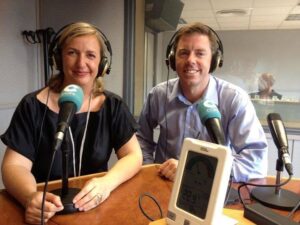
Being interviewed in Spain on National Radio
More Than Hearing the Words
That idea has followed Morrison through a career spanning technology, product development, solutions engineering, sales, customer success and business leadership.
His work has often placed him between people looking at the same problem from entirely different perspectives.
“Listening begins with empathy. But empathy alone is not enough,” Morrison says. “You also have to understand what perspective they’re coming from.”
Two customers can describe the same challenge in nearly identical language, yet experience it very differently. One may carry financial responsibility for the success of a clinical trial. Another may be managing an overworked clinical site and trying to get answers quickly enough to keep a staff moving.
The words may be the same, but the stakes are not.
Since joining Thalocan in April as Head of Customer Enablement, hearing both what someone is saying and what sits behind it has become central to Morrison’s role…helping clients understand what they have and how to effectively use it.
He has worked inside large organizations but has also helped emerging technologies and young companies find their footing.
“Startups can be chaotic, he says. Priorities shift, processes are still being created, and remote work with an international team adds another layer.”
He describes it with one word: challenging.
Then he clarifies, “Challenging in a good way.”
A Different Kind of Technology Work
Morrison came to Thalocan through relationships stretching back more than a decade. He previously worked with Thalocan COO Cyrus and knew Tyler, a member of the sales team. When they called about a growing company that needed his mix of skills, he listened.
Clinical research was not entirely unfamiliar.
Earlier in his career, Morrison worked for laboratory equipment manufacturer Mettler Toledo, spending his days in Northern California research laboratories, from universities and pharmaceutical companies to federal and military facilities, talking with researchers about the equipment they depended upon.
Still, Thalocan offered something different.
Morrison most recently worked in the data brokerage industry, eventually overseeing a business within Ziff Davis. The company operated ethically, he says, but the larger reality of how personal data is collected, traded and used increasingly troubled him.
At Thalocan, the purpose of the work was easier to see. “The end goal was to improve the lives of people who were suffering.”
That difference has become especially tangible as he prepares to take on LAMA demonstrations and clinical staff training. The work requires him to regularly view images of skin conditions that can be highly visible and socially isolating or hidden beneath clothing while causing tremendous pain and discomfort.
Seeing those images has made the patient experience harder to view abstractly. “It makes me very empathetic,” he says.
And it reinforces what he values about his new work.
“There’s no stretch to say this is making people’s lives better. Even though it’s technical, there’s such a human component to it.”
Ahead of the Playbook
Morrison’s path into technology began at a moment when the industry itself was still finding its footing.
He had been taking computer science courses at UCLA while still in high school, but family circumstances changed his plans. Later, after moving to Berkeley, he took a part-time job with an internet startup.
The timing changed everything.
Technology was evolving quickly, and companies were searching for people who could keep up with it. There were few established career paths, fewer proven processes and often no real playbook for what came next.
Morrison found himself in exactly that kind of environment.
The job grew, and his career grew with it, launching a professional path repeatedly shaped by emerging technologies, new markets and problems that had not been solved before.

Helicopter flying in Mallorca
A Lust for Life
That curiosity does not stop when the workday ends.
Morrison is a voracious reader and lifelong cyclist. Before having children, a typical weekend might include a 100- or 120-mile ride. After being struck by a motorcycle when he was younger and breaking all four limbs, high-impact exercise became difficult, but bicycles remained.
So did his fascination with old machines.
He has restored a vintage espresso machine and worked on motorcycles, cars and aircraft. He sails. He holds a skydiving license. His aviation experience includes fixed-wing aircraft, helicopters and hot-air balloons.
Travel is another constant. Morrison has visited more countries than U.S. states and recently returned from nearly three weeks in China with his wife and their young sons.
He sums up the collection of interests simply.
“I just love sucking up all of that good stuff in life!”
Then he laughs.
“A lust for life.”
One object seems to bring several of Morrison’s interests together: the pen that belonged to his great-grandfather, Duncan McCowan, a schoolteacher on a small island in Scotland. It still bears his initials.
Morrison values handwriting and language, the tangible evidence of how people communicated before communication became instantaneous. For someone whose career has unfolded alongside rapidly changing technology, he remains deeply interested in the parts of human interaction technology cannot reproduce.
 What Comes Next
That tension is part of what excites Morrison now.
While at Ziff Davis, he noticed financial forecasting becoming unexpectedly difficult as companies across industries struggled to predict what artificial intelligence would mean for their businesses.
In a position to speak regularly with leaders across sectors, Morrison began asking them a simple question:
What is your AI plan?
The conversations sent him deeper into what AI could mean technically, culturally, economically and professionally. What he found was both exciting and unsettling.
Now, he sees Thalocan operating during a period of technological change reminiscent of the early internet boom, only faster.
There is risk. There is also opportunity.
For Morrison, it is meaningful to explore that opportunity inside a company whose technology remains connected to deeply human needs. Patients still experience disease. Clinical teams still need effective tools. Customers still need to understand what they are using and why.
And someone must listen closely enough to understand what they really need.
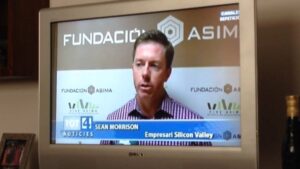
That may be the thread connecting the British schoolboy adjusting his accent in Norway, the writer explaining Silicon Valley culture to European entrepreneurs, the technology executive translating between engineers and customers, and the newest member of Thalocan’s growing team.
Different languages. Different industries. Different problems.
But the lesson Morrison learned early has stayed remarkably consistent: communication is never just about the words being spoken. It is about understanding the person on the other side. And after a career spent doing exactly that, his answer to the question, “What do you do?” is still surprisingly simple.
“I help people communicate.”
Click here to meet more of our Thalocan Family